.png)

The Real Game of Life
Get educated on the Public Service Commission from a board game!
In this interactive game, players will explore the role and responsibilities of the Public Service Commission of Wisconsin (PSC) in regulating Wisconsin’s utility companies. Players will leave with a clear understanding of how inequities in the regulatory system impact community health, as well as opportunities for public engagement and advocacy within that process.

It's Interactive Education!
The purpose of this game is to educate players on the role of the PSC and demonstrate how PSC decision-making impacts community health.
The team at Healthy Climate Wisconsin has educated over 70 people about the Public Service Commission by playing The Real Game of Life. Here’s what some of them said:
I enjoyed the game you played with us. It was a fun and interactive way to learn about how climate is affecting us.
The game you shared with us today not only was incredibly thorough but it was also informational and a great way to paint the picture to those who may not fully understand some of the disparities people experience.
The board game was enlightening on how energy companies target certain communities that are less fortunate while rubbing shoulders with politicians.
I appreciate how you made a complex topic easier to grasp with the modified game of life, while still grounding it in reality.
Objectives
-
Define the role of the Public Service Commission (PSC) and other key factors that influence energy costs. → Introductory presentation
-
Examine inequities within the current PSC and utility systems and how they impact different groups. → game
-
Discuss how energy burden impacts individuals and communities in daily life. → game
-
Explain the barriers to effective utility regulation and identify opportunities for public engagement and advocacy within the regulatory process. → debrief
Gather your materials
You’ll need at least six players to play the game. If a seventh person is present they can be the bank, otherwise this role can be assigned to any player except Bee Energies Utility Company.
Gather the following:
-
One dice
-
One set of Monopoly money
-
Six player placeholders (Just like Monopoly, this could be anything! A paperclip, a pen cap, an eraser, a scrap of paper, etc.)
-
Six pens or pencils
Print these items:
- the PSC and Event card decks
-
The character sheets (These are a one time use, new character sheets need to be printed after each game)
-
The board game (Recommended printing size is 24" width by 18" height)
Download to Print
Card Decks
Character Sheets
Board Game
Start the game
At the start of the game, have each player select a character sheet and designate one person to be the bank (Bee Energies Utility Company cannot be the bank). Then introduce your character names in a clockwise direction. Also state your income and what city you live in. The bank can start distributing the starting money to each character (shown on the character sheets). Roll the die to determine who goes first, then take turns clockwise.
Meet the Characters
Bee Energies
Utility Company
Starting money: $3,000
Dave D. Center
Starting money: $1,000
Resides in:
Weathering Heights
Connie Gress
Resides in:
Weathering Heights
Starting money: $1,000
Jenny Rator
Resides in:
Electric Park City
Starting money: $500
Uma Thermastat
Resides in:
Electric Park City
Starting money: $500
Gus T. Wind
Starting money: $200
Resides in:
Electric Park City
Play your first round
Roll the die at the beginning of each turn. Complete the action in the square you land on, this will either be to draw a card from the PSC or Event card deck, or to collect a payday. You can collect your salary when you land on or pass a payday square. Keep track of the changes to your utility bill on your character sheet.
For example, see how the following cards will affect your utility bills:
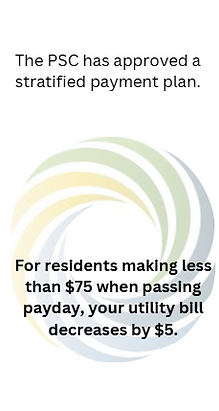


Make sure you read each card aloud as you play so everyone can hear, understanding the event and impact of each card is an essential part of the game's education.
Put cards in a seperate discard pile after you play. If you reach the end of the deck, re-shuffle and use the cards again. Some cards do not apply to Bee Energies Utility Company, most of these cards have been marked but use your best judgement!
Utility bills are paid to Bee Energies Utility Company. All other payments go to the bank, unless the card says otherwise.
At the end of each round, remember to have all characters pay their utility bill to Bee Energy Utility Company. Designate a player to go last and be responsible for reminding players when bills are due!
Winning and losing the game
Winning the game: The game is over when the first player reaches the end of the board game. At that point everyone can count their money and the character with the most money wins.
Losing the game: If your character runs out of money, you are out of the game until you recieve money on a pay day or group event.
Is it important to finish the game? No. After a few rounds players will begin to grasp the main takeaways. Remember the point of the game is not to win, but to come away with a strong understanding of the role of the PSC and how their decisions impact community health. We recommend allocating about 15 minutes to play the game. At that point, you can end the game and move into the group debrief.
Debrief main takeaways
After the game, players can debrief and reflect on what they learned. Take five to ten minutes to discuss main takeaways. Consider these questions:
-
What did you notice?
-
What role did the PSC (cards) play?
-
How does the PSC influence equity?
-
How were different game characters impacted by PSC and event cards?
-
How did different neighborhoods or characters experience different outcomes or stressors?
-
What advocacy actions can be taken to promote health equity?
Also, discuss the differences between the game and the real-world. See this slide in our PowerPoint.
PowerPoint
Connect with Us
Would you like to talk further about how to bring The Real Game of Life to your next community educational session? Please reach out! Email julia@healthyclimatewi.org.